

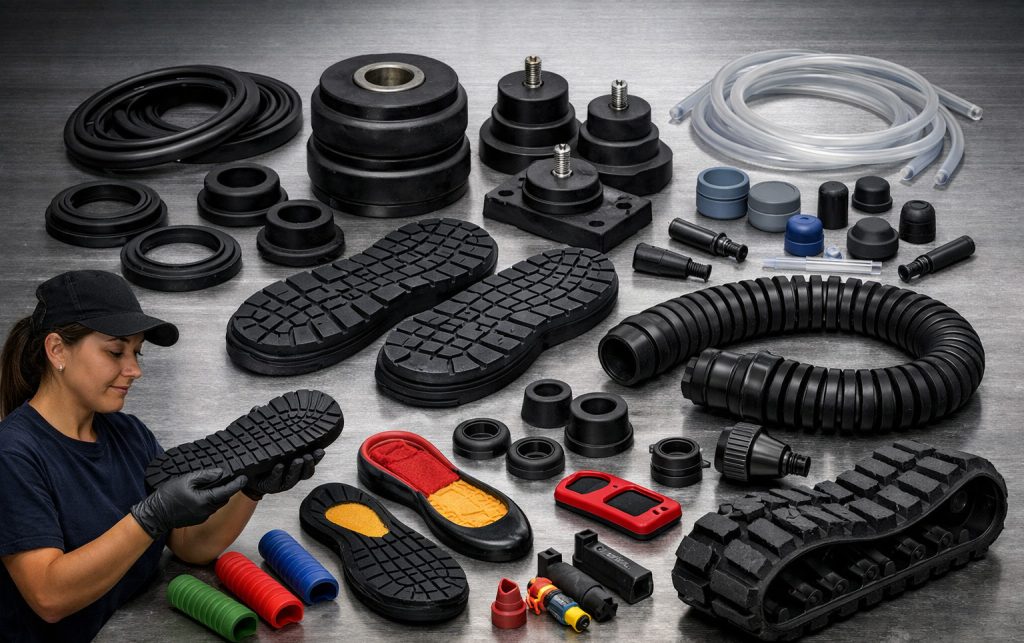
Rubber‑molded products are essential components across modern industries, providing durability, flexibility, and resistance to harsh environments. From automotive seals to medical tubing, molded rubber plays a critical role in ensuring safety, performance, and reliability in countless applications. Their versatility comes from advanced molding technologies and specialized rubber compounds engineered for specific conditions.
1. What Are Rubber Molded Products?
Rubber‑molded products are components manufactured by shaping raw rubber—natural or synthetic—into precise forms using heat, pressure, and molds. These products can be soft, rigid, flexible, or highly resistant depending on the formulation and manufacturing method.
Common molding processes include:
- Compression molding — ideal for large, simple shapes
- Injection molding — high precision, high volume
- Transfer molding — excellent for complex geometries
- Extrusion + secondary molding — for hoses, tubing, and profiles
2. Materials Used in Rubber Molding
Different industries require different rubber properties. Common materials include:
- Natural Rubber (NR) — high elasticity, abrasion resistance
- EPDM — excellent weather and ozone resistance
- Nitrile (NBR) — oil and fuel resistance
- Silicone Rubber — heat‑resistant, medical‑grade purity
- Neoprene — balanced chemical and weather resistance
- Viton (FKM) — premium chemical and temperature resistance
Each compound is engineered for specific performance requirements such as flexibility, hardness, chemical resistance, or thermal stability.
3. Major Categories of Rubber Molded Products
A. Automotive Components
Rubber is indispensable in vehicle manufacturing:
- Seals and gaskets
- Bushings and vibration mounts
- Fuel and coolant hoses
- Weatherstripping
- Engine and transmission components
These parts ensure safety, comfort, and mechanical reliability.
B. Industrial Equipment
Factories rely on molded rubber for:
- Conveyor rollers
- Vibration dampers
- Machine feet and mounts
- Expansion joints
- Protective covers and sleeves
These components reduce noise, absorb shock, and protect machinery.
C. Consumer Goods
Rubber enhances everyday comfort and usability:
- Shoe soles and insoles
- Tool grips and handles
- Phone cases
- Floor mats and anti‑slip surfaces
These products combine ergonomics with durability.
D. Medical & Laboratory Products
Medical‑grade rubber must meet strict hygiene and safety standards:
- Silicone tubing
- Syringe plungers
- Rubber stoppers for vials
- Seals for pumps and medical devices
These components require biocompatibility and precision.
E. Electrical & Electronic Applications
Rubber provides insulation and protection:
- Cable grommets
- Connector boots
- Switch covers
- Shock‑absorbing mounts
Silicone and EPDM are common due to heat and electrical resistance.
F. Agricultural & Construction Products
Heavy‑duty rubber supports demanding environments:
- Tractor seals and hoses
- Rubber tracks
- Shock pads
- Protective boots and gloves
These products withstand abrasion, chemicals, and extreme weather.
4. Advantages of Rubber Molded Products
Rubber components are chosen for their unique performance benefits:
- Waterproof and airtight sealing
- High flexibility and elasticity
- Resistance to chemicals, oils, and fuels
- Shock and vibration absorption
- Thermal and electrical insulation
- Long service life with minimal maintenance
These advantages make rubber indispensable across industries.
5. Quality Control and Testing
To ensure reliability, rubber products undergo:
- Hardness testing (Shore A)
- Tensile strength and elongation tests
- Compression set testing
- Chemical resistance evaluation
- Dimensional accuracy checks
- Aging and weathering tests
High‑quality molding ensures consistent performance in critical applications.
6. The Future of Rubber Molding
Innovation is driving the next generation of rubber products:
- Eco‑friendly rubber compounds
- Automation and robotics in molding lines
- Smart materials with embedded sensors
- Recycling and circular‑economy solutions
These advancements improve sustainability, precision, and efficiency.
Conclusion
Rubber‑molded products are foundational to modern industry. Their adaptability, durability, and performance make them essential in automotive systems, industrial machinery, consumer goods, medical devices, electronics, and heavy equipment. As technology evolves, rubber molding continues to advance, offering smarter, stronger, and more sustainable solutions for global manufacturing.


